
Decks That Look Maintained, Not Neglected
Deck cleaning in Wytheville for surfaces showing discoloration, buildup, or weathered wood grain
Outdoor Elements handles deck cleaning in Wytheville for wood, composite, and plastic wood decking surfaces that have accumulated grime, algae, tannin stains, or embedded dirt that regular rinsing cannot remove. Many decks in this region are attached to single-family homes built during the 1980s and 1990s, a period when pressure-treated lumber was the standard material, and those older boards develop a distinctly gray, fibrous surface texture over time that signals oxidation rather than simple dirt. That surface change is what cleaning addresses directly.
The cleaning approach Outdoor Elements uses depends on the decking material, because composite and plastic wood products such as PVC-based boards respond differently than natural wood and require lower-pressure application with specific detergents that lift organic buildup without abrading the surface finish. Pressure-treated and natural hardwood boards tolerate more aggressive cleaning but need careful technique at board edges and between gaps to avoid fiber raise. The process typically begins with a pre-treatment solution applied to the full surface, allowing dwell time before any rinsing or pressure application begins.
Arrange an on-site evaluation to assess your deck's material type and current surface condition before work begins.
What Proper Deck Cleaning Actually Requires
Effective deck cleaning is not a single-step rinse. For natural wood decks, the process involves identifying whether staining comes from tannins, algae, mildew, or iron oxidation—each of which responds to a different cleaning chemistry. Tannin bleed from the wood itself produces dark streaking, while algae colonies create a greenish or black film that becomes slippery underfoot. Matching the cleaning agent to the stain type determines whether the surface comes clean or whether repeated passes are needed.
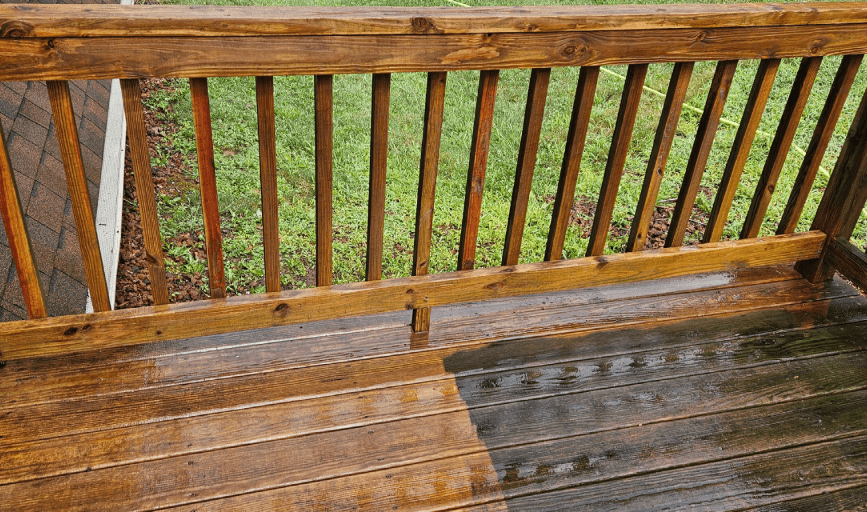
Once cleaning is complete, the visible result on a wood deck is a return to the board's natural grain color and a uniform tone across the surface, without the patchy gray or black areas that were present before. On composite and plastic wood decking, the surface loses its chalky or streaked appearance and returns to the consistent color the manufacturer intended. Fastener areas and board ends, which tend to hold the most organic material, become visibly cleaner and the gaps between boards open up rather than appearing packed.
For wood decks that will be sealed or stained after cleaning, the cleaning step is a prerequisite—applying a finish over a contaminated surface traps the staining underneath and causes the new finish to fail prematurely. Composite and plastic wood decks generally do not require sealing, but cleaning restores their surface to a condition where the board's UV-inhibiting finish layer can function as intended rather than being buried under biofilm.
Answers About How the Work Is Done
Deck material type is the primary variable that shapes every decision in the cleaning process, from chemical selection to equipment settings. The questions below address how those decisions are made.
What cleaning method works for composite and plastic wood decking?
Composite and plastic wood boards require low-pressure soft washing with detergents formulated specifically for polymer-based surfaces, because high-pressure application can etch the protective cap layer that gives those boards their color and stain resistance. The nozzle distance and pressure setting that works on pressure-treated lumber would damage most composite products permanently.
How does cleaning preparation differ between wood and synthetic decking?
Natural wood decks benefit from a brightener or oxalic-acid-based solution applied after the main cleaning agent to restore pH balance to the wood fiber and bring back the board's natural tone, while composite and plastic wood decks skip that step entirely since they do not have an open grain that responds to brightening chemistry.
Why does algae return on some decks more quickly than others?
Decks with significant shade coverage or positioned beneath tree canopy accumulate organic debris faster, and if the deck boards have any surface texture—either from weathering or the manufacturer's design—they provide more surface area for spores to anchor. Cleaning removes the existing colony, but the rate of return depends on how much organic material continues to land on the surface.
What should you check in the finished work to confirm the cleaning was thorough?
After cleaning, board gaps should be clear of compacted debris, fastener heads should be free of dark oxidation rings, and the surface color should be consistent from board edge to board edge without remaining dark patches. In Wytheville, where many decks sit adjacent to wooded lots, checking the shaded corners and railing post bases for residual biofilm is a reliable quality indicator.
How do you know when a deck needs cleaning versus replacement of boards?
Boards that return a consistent color across their face after cleaning are structurally sound enough to maintain. Boards that show soft spots, deep checking along the grain, or surface that crumbles when probed are candidates for replacement, and cleaning will not restore structural integrity to wood that has deteriorated past the surface layer.
Outdoor Elements works with wood decks, composite surfaces, and plastic wood installations, so the cleaning method is matched to what you actually have rather than applied as a one-size approach. Contact Outdoor Elements directly to describe your deck material and current surface condition, and to schedule service at a time that works for your property.